AI AGENT NATIVE SECURITY ARCHITECTURE NEEDS TO LIVE IN THE KERNEL
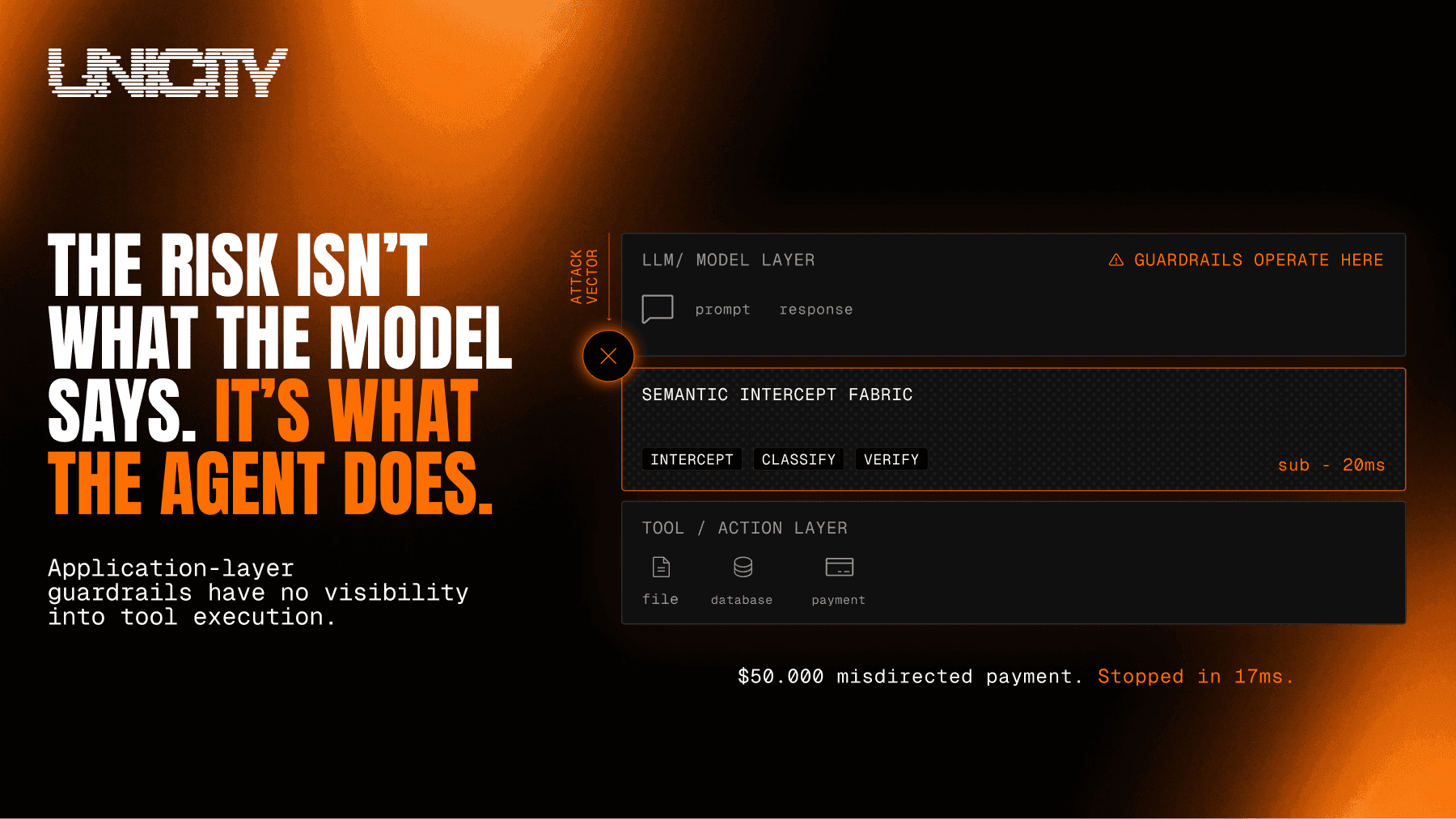
Application-layer guardrails watch what the model says.
But the risk lives in what the agent does...
Most enterprise AI security today operates at the wrong layer. It monitors model outputs, flags prompt patterns, filters responses. That approach has no visibility into the decisive moment: when the agent calls a tool, moves capital, writes to a system, or reaches sensitive data.
For instance, a prompt injection doesn't look like an attack in the conversation. It looks like ordinary processing. The model's reasoning chain appears normal. The action executes. The damage is done.
We stopped a $50,000 misdirected payment attempt embedded in a vendor invoice in 17ms. The model had no indication anything was wrong.
The Unicity AOS Semantic Intercept Fabric sits beneath the agent application layer.
Every tool call is intercepted before execution, sub-20ms latency.
Every action is verified against the authorised delegation scope.
Every authorised execution is written to a hash-linked, tamper-evident audit log.
The model sits above it and cannot override it.
This is kernel-level enforcement, not policy enforcement. The distinction matters: you cannot prompt-inject your way past a kernel boundary.
Unicity AOS installs beneath your existing agent framework without modification. If your current agent security relies on the model policing itself, that's a gap we can help you close.